Showing posts with label DATE Night. Show all posts

Friday, January 6, 2012

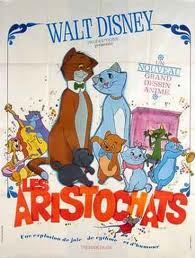
DATE Night: The Aristocats

Start the car. I know a whoopee spot.
Now that we've left the jungles of India (hopefully sans any exotic diseases) of two hundred years ago with The Jungle Book, we're going to spend our DATE Night a century later in France seen through the filter of swingin' sixties jazz. So pack away the mosquito netting and pull out your shades and upright bass, cuz we're about to get down. Solidly outside of the second golden age of Disney animation at this point, we see a lot of the trends that will come to define this awkward period in the canon having really entrenched themselves. If the first golden age was "Aw, look at what a beautiful and smart baby you are!" and the second golden age is "Aw, look at what a beautiful and smart young child you've become!" (with the package films of the forties being that short, weird, chubby phase in-between that is quickly outgrown), then this is now the awkward teenage-like period where the films are trying to make sense of who they once were and who they are going to be while concurrently trying desperately to exist on their own terms. It's not always pretty. The third golden age will be the "Aw, look at what a beautiful and smart adult you've grown into!" But that's almost twenty years away. For now, we get to watch the adolescent growing pains of the Disney animated feature continue with number twenty. The Aristocats.

The Background:

En Francais, bien sur.
So The Jungle Book was a rousing success and as the first animated feature released after Walt's death / final one that he worked on directly, it set quite a high bar for the studio to match after the loss of their leader. Collaborators who had worked on the last few films, including director Wolfgang Reitherman, composer George Bruns and songwriters the Sherman Brothers helped shape this next film, The Aristocats. The film was an original story that was intended to be made as a two-part live-action Wonderful World of Disney TV movie. Walt felt that it would be better suited to be an animated feature and so approved work to start on it after The Jungle Book had wrapped, not knowing at the time that he would not be around to oversee the project.

The studio moved ahead with The Aristocats, which was released three years later in 1970, as the first post-Walt animated film. (While we're at it, I wrote a guest blog post for the fully awesome This Happy Place Blog called "The Blessing and Curse of WWWD" that explores Disney's shift in creative philosophy after the loss of Walt. Please check it out!) While it did not set the world ablaze, it was not an abysmal failure either. Critics weren't terribly enthusiastic at the time of its release, but audiences still came and it was re-released into theaters twice during the eighties. It also did well overseas and was a big hit in France. (Duh.) History, however, has not been terribly kind to the movie, which has earned a reputation as rather derivative and mediocre if not downright forgettable film with a devoted group of supporters (Apparently Snoop Doggy Dogg, who proclaims, "Ya don't like this movie, stay outta my tilt" is among them. Tres eloquent, Snoop.) rather than one of the top-tier animated classics. A sequel was planned and then scrapped and the characters, mostly meaning Marie, show up here and there in the parks and merch. 

The First Impression:

The Disney Project- Part 14: The Aristocats. Seems like a mashup of elements of "Lady and the Tramp", "101 Dalmatians", and "The Jungle Book". There are lovely little moments but on the whole it's the law of diminishing returns. It seems like the superior Disney artistry and storytelling are fading. I am a sucker for cute kittens and Eva Gabor, but once again, I liked this one and didn't love it.
February 12, 2010 at 1:18pm ·

The Art:

Lovely background work.
6/10. The Aristocats is much more artistically sound than I remember it being. Though I'm still not a huge fan of the rough and sketchy Xerox look that has become a staple of the Disney animated films (and sometimes becomes rather distracting in places like Madame Adelaide's white hair, which has so many stray markings it sometimes looks like an alien is trying to devour her head), I am accepting it and trying to look at the film on its own terms beyond that. There is much to admire here. I love the moment at the opening where Toulouse throws paint of a canvas and, as it drips, it becomes the landscape we enter. The backgrounds are lovely and reminiscent of 101 Dalmatians, but less abstract and with a watercolor flavor. The character animation and designs are all very strong, as is the effects animation in places such as the lightning and water. I love the moment where you see Madame in the window, waiting for her cats to come home to her, and it looks like the house is crying as well. The use of color, light and shadow are impressive in moments like the attic cum jazz club's Tiffany lamp psychedelic colors, the silhouettes of Duchess and O'Malley giving way to the Paris skyline, or the yellow light from the window illuminating the car near the end of the film. There are wonky bits, like the weird, flat feel of the moments when the cats are walking with the geese (where was the multiplane camera, guys?) or the very Looney Tunes dollar signs in Edgar's eyes, but overall, there is a pretty strong, creative aesthetic voice at work here.

The Story:

Yeah, yeah. That's cute and all, but...
5/10. The biggest flaw in the movie is the fact that it has no idea what it wants to be as an original animated feature. Instead of finding its own unique voice (it's fascinating to imagine a version that looks to the period and time of France in 1910 for inspiration), it borrows elements that had been successful elsewhere without considering that they worked because they sprang organically from the story and creative process in the first place. We borrow the story of a pair of romantic pet leads where she is fancy and he's more rough and tumble from Lady and the Tramp. We lift the jazzy elements, Phil Harris (Baloo), and his unique persona from The Jungle Book. Then we throw in a plot where the animals are stolen and must find their way home from 101 Dalmatians. It's a matter of these outside forces dictating the story rather than inform it. The movie even purloins itself in the end when it turns the final moments into an excuse to abruptly reprise of it's showiest number and bring characters back as if in a curtain call.

...this is what I call a super fan. Wowza!
To make up for the lack of a unique, strong narrative, the film was padded with lengthy chase scenes that have nothing to do with the central story arc involving the cats, musical production numbers that feel as out of place as they do fun, and story tangents that stop the plot cold rather than move it along. Why do we follow the geese for what feels like forever? Why do we need two motorcycle chases with the hounds and Edgar? Sometimes the side trips are pleasant, but they do absolutely nothing but distract from the reason why we're there. Walt had a good eye for fat that deserved to be trimmed. Remember that he cut a nearly completed soup-eating scene from Snow White that was charming as heck but slowed the story and it's that kind of editorial perspective that was sorely needed here. The movie certainly tests your ability to suspend disbelief. How can the authorities be so baffled over the missing felines when the very day that Madame Adelaide's will was written, leaving Edgar her fortune if anything happens to the cats, something happens to the cats? Edgar would be the first person you would confront. The whole premise doesn't hold up under even gentle scrutiny.

That being said, there are some strong moments to be found. The opening credits sequence with the bare bones animation and theme song is fun and the end title bopping one of the hounds in the head makes me chuckle. I love the moment when the man in the cafe dumps his wine out after seeing the cats hustle past him, as if he believed that they were an alcohol-induced hallucination. And the major triumph is that when they stick to the story of the cats, they really do a beautiful job of storytelling. Despite all of the distractions, you still really get invested in the story of these core characters that you have totally fallen for. You want them to get home, root for the love story, and are scared when they are almost hit by a train. The problem is that while the magpies on the creative team got taken with all of the shiny things they were inserting to add interest, they were really just making you wish they would get back to the part of the story that you actually give a rat's behind about.

The Characters:

They all kept their eyes closed so they could
submit this to Awkward Family Photos.
6/10. The characters in The Aristocats are frustratingly uneven, though they are all animated quite well with a lot of skill and emotion. Let's start with the good, shall we? The characters at the center of the story, the cats themselves, are dimensional and endearing. The studio continues wisely to use children to voice the little ones and each of the three kittens is so adorable that you just want to take it home and cuddle it. Eva Gabor's voice alone brings a regal yet kind quality to Duchess that contrasts well with the charming, lackadaisical O'Malley, even though it's essentially the same performance that Phil Harris gave as Baloo. It's a classic case of opposites attract. Many of the supporting characters are wonderful as well. Sterling Holloway brings his usual magic to the role of Roquefort. Watching him, there were a lot of collective squeals filling the apartment regarding how sweet, loyal and adorable he is. Madame is appropriately fancy but warm and her elderly but spritely lawyer Georges made me laugh out loud with some great physical humor. All of the O'Malley's stray cat buddies are good times, even if they end up dipping their toe into the realm of racially insensitive. Their leader, Scat Cat, was originally slated to be played by Louis Armstrong, who backed out before recording began and was replaced by Scatman Carothers, who does an admirable job in the role.

I'm on the other end telling him what a lame villain
I think he is. Sorry bout it.
Now we come to the not-so-good. The hounds and the geese may pull us too far from the story, but they have fun banter and are pleasant to watch. I just wish it had been in short subjects, out of the context of this movie. The fact that they are wasted here speaks more to the fact that the filmmakers were having a lot of story issues than a lack of mastery on the animators' and performers' parts. They are rendered well though they are absolutely unnecessary. The weakest character by far is our villain, Edgar. He's not enough of a bad guy. He feels so wishy-washy that you never really see a spark of danger in him and without that you undermine the stakes of the whole story. It doesn't help that a large chunk of his screen time is swallowed by the peripheral hound chase scenes. I may even go as far as to say that he may get my vote for the weakest villain in a Disney animated classic. Ho hum.

The Music:

Paint + Piano = Hijinks!
6/10. The songs in The Aristocats are a mixed bag. The Sherman Brothers provided a number of them for the film, most of which went unused, which is the flip side of The Jungle Book, where they were brought into replace all but one of Terry Gilkyson's original songs. (I guess turnabout is fair play, eh?) They coaxed Maurice Chevalier out of retirement to sing the title number for the opening credits and it proved to be his final recording before he passed in 1972. The song is also quite charming and sets the tone well, as does their charm number "Scales and Arpeggios", which serves to endear the characters to you (and which I have a soft spot for because it used to be a standard warm up at one of the youth theaters I performed with). If the entire score had been in this vein, it would have made for a more cohesive film, certainly, but it seems that they wanted to make room for chase scenes and, entertaining as they may be, out-of-place showcase numbers. Watching the DVD, there was a special feature highlighting the (mostly) cut number "She Never felt Alone", which gave emotional weight to the relationship between Madame Adelaide and the cats. It's a moving song that focuses on how special their relationship was, making the stakes of needing to return to her higher. It's exactly the kind of thing that the flimsy story could have used more of.

Those colors! Groovy, man!
There are two other big numbers in the movie. The first is "Thomas O'Malley Cat" by Terry Gilkyson, who also wrote "The Bare Necessities". Meant to provide a statement of character, it is obviously an attempt to capture the magic of The Jungle Book number by reuniting songwriter and performer, and ends up feeling like a throwaway retread in both construction and execution. The second is the showstopper "Ev'rybody Wants to be a Cat" by Floyd Huddleston and Al Rinker. The psychedelic, swinging, Dixieland jazz number is odd, from left field and over the top, but is also so much fun that you absolutely have to forgive its flaws. It also does a better job of establishing who O'Malley is than the song that's named after him, though it comes late in the game. It also shows that Duchess is not as high-toned as she sometimes seems when she contributes her own lovely b-section, which was sung by uncredited studio singer Robie Lester, who was one of the go to girls on the Disneyland storyteller records back in the day. It is made clear that the romantic leads and the three kittens fit together as a cohesive unit by letting them all participate in a song with one overriding musical voice. Duchess and the kittens can belong in his world.

I heart Roquefort. That is all.
The score is once again by George Bruns, who is pretty much brilliant. I have been playing the soundtrack to the movie over and over again and have been mostly impressed by how diverse and yet consistent his score is. The sounds go from Dixieland to French cafe to frug to classic film score, all completely in support of the story that's being told. The score signals flirtation, danger, sadness, joy and everything in between and it's all filtered through the sixties-ish George Bruns sound that I have come to adore from him over the course of the last few films and my recent obsession with the 1964-1965 New York World's Fair. His work here is almost better than the movie deserves and often makes sequences play better than they really should (cough***chase sequences***cough).

The Gay Scale:

I wish I know how to quit you, Lafayette.
5/10. For a film that takes place in France, there is precious little in this film that is terribly gay. Huge missed opportunity if you ask me. There is that odd Brokeback moment between Napoleon and Lafayette, but that's really stretching it. The majority of this rating is thanks solely to the presence of a Gabor in the film. Eva Gabor is no doubt a minor gay icon (even if we still get her confused with Zsa Zsa now and then) and her performance as Duchess is in the Auntie Mame tradition here. The Hungarian actress' delicious accent and distinctly musical voice are like (teehee) catnip to a queer audience who has loved her since she played a diva gone country in the Green Acres TV show. She is the kind of sweet, kind, gorgeous, refined, eccentric, caring, artsy, with-it mother figure that gays long for. I can't say I would be shocked if either Berlioz or Toulouse turns out to be light in the loafers.

The Bottom Line:

Get down witcha bad self, gurl.
6/10. The law of diminishing returns has really taken effect and this film feels like a rehash of several past movies, cherry-picking elements from 101 DalmatiansThe Jungle Book, and Lady and the Tramp, throwing them into a blender and hoping that the concoction they end up with is palatable. Luckily for them, there is enough charm and fun to keep this movie from being a disaster. Sadly, it never really rises much above mid-level Disney animated fare, despite its sense of innocuous joy. This movie really hammers home the fact that the studio was not reaching for what is new, different and untried, but rather reaching backwards and reusing elements from before. It is a dangerous trend for a company built on the foundation of innovation. Despite this lack of freshness, especially in the story department, the fun characters and performances, breezy music and jazzy score that overcome being (for the most part) out of place in early-1900's France, and charmingly sketchy and colorful artistic look make this fun to watch and keep its head above the waters of glaring failure. I certainly enjoyed this more than I did watching it a year ago, but I can't say I count myself as a member of the Aristocatic party.

The Miscellanea:

I have been rather surprised of late to see so much of Marie in the parks. She is all over France in Epcot especially, which strikes me as odd since there is a bonafide French princess, who I would expect to dominate the area, in Belle. Not that I'm complaining, mind you. I think Marie is adorbs and like seeing less obvious characters in the parks and merch. I have come to find out that her resurgence is thanks to the Japanese, who have a predilection for all things cute. (They are also the ones to thank for the rebound of the Orange Bird, who has become somewhat of a hero to me. So thanks, Japan!) As I mention all the time, I love a good character encounter and this video of Marie in France at Epcot just makes me giggle. It helps to answer the burning question, "What exactly do the characters do when the park is slow and there's no one to greet?" The surprising answer may well be that they bust a move, which in this case is completely appropriate based on the "Ev'rybody Wants to Be a Cat" number from the film. Meow, gurl. Me-ow.


In this video, Phil Harris and Scatman Crothers reminisce about The Aristocats for 1978 TV special in honor of the 25th anniversary of The Wonderful World of Color/Disney. They were and will always be two of the coolest cats who ever lived and it's really lovely to see the easy way that their repartee fires back and forth. And I'm not gonna lie. Phil Harris reminds me a lot of a jazzy version of my country music loving dad, who I have come to really appreciate of late. This whole clip warms my soul.


This is a remix somewhat in the vein of the ones done by Pogo, which I shared in an Odd Disney World entry a while back. It's called "Feline Good" and is quite good. It doesn't have the same haunting, creepy quality that really sets Pogo's arrangements apart. It's more like a really fun dance remix of "Ev'rybody Wants to Be a Cat". Well done, sister suffragette.


Of course "Ev'rybody Wants to Be a Cat" is the song from the movie that is most often covered. This is a fascinating take on the song by the Tiffany Ensemble. It's got a more classical bent to it and is quite impressive.


This version is very interesting. It is by a group called Psapp, who you may know as the band who does the theme music from Grey's Anatomy. It's quite good, with a trippy arrangement, sultry female vocal, and more chilled out vibe.


This cover is by a group called The Boop Sisters. I can't find much about the group online, but this is like the Andrews Sisters singing "Ev'rybody Wants to Be a Cat" in Italian at a supper club during the forties accompanied by a big band. I believe there's also either a child or a member of the group that imitates one well thrown into the mix. It's pretty much fully awesomesauce.


This weird cover of "The Aristocats" is from a non-Disney children's album on the Happy Times label called The Aristocats and Purr-ty Pussycat Songs. It's performed by a nameless pair of singers accompanied by keys, drums, and a random wah-wah guitar. It's very odd, but upbeat and strangely compelling.


So do you think that The Aristocats is a descent further into the murky waters of mediocrity or buoyant like a pair of those orange water wings they used to make you wear when you hadn't learned to swim yet and made farty noises as you squeezed them up your arms? Did you find it charming or derivative? Do you want to be a cat like ev'rybody or are you more of a dog lover? Next up on our DATE Night, we'll head into the forest of Nottingham for Robin Hood. Please wear comfortable shoes so that if we have to run away from flying arrows I'm not stuck fashioning a tourniquet out my shirt to stop your blood loss. I would probably do it wrong anyhow. What? You thought you were out with a boy scout? Sorry, love.

Tuesday, January 3, 2012

DATE Night: The Jungle Book

How about this? Let's kind of pretend that our last DATE Night, the one where we spent an hour and a bit of our lives that we'll never get back in King Arthurs's court with odd duck The Sword in the Stone, had never happened. If that were the case, then we would still be riding high on the triumph of 101 Dalmatians, and the decline in quality of Disney's animated features would be much less pronounced than the abrupt end to the second golden age that Merlin & Company conjured for us. As I warned you, this period is marked by artistic inconsistency, with huge artistic pendulum swings from brilliant to boring, sometimes within one film. The Jungle Book, luckily is definitely a step up. If not at the level of what Disney animators are capable of at best, it's still fun, breezy, well-done and artistically solid.

The Background:

One of Bill Peet's story sketches.
After the less than stellar performance of The Sword in the Stone, master story man Bill Peet, who was one of the driving forces behind the previous two films, brought the idea of adapting Rudyard Kipling's The Jungle Book to Walt. After getting approval, he drafted a film that kept the dark tone of the novel. Walt wanted to assert his presence more than he had on the past several animated features and insisted that the film be lightened up. The two passionate men couldn't find middle ground, Peet (who had been at Disney since just after Snow White) left his job at the Studio, and Walt guided the film in the more lighthearted, emotional, character-driven direction he envisioned. The movie would prove to be the final animated classic to have Walt's direct fingerprints on it.

Walt Disney died in December of 1966 and the film was released almost a year later in October of 1967. Critical praise was abundant, owing in part, no doubt, to the nostalgia related to Walt's passing, and box office numbers were extremely strong. Several of the songs have since become standards and the characters have a pretty steady presence on TV, in spinoffs and in the parks. The Jungle Book has been pegged in our collective conscience as one of the better Disney animated features, remembered fondly and widely enjoyed by new generations. Depending on how much of a stickler you want to be about such things, the movie could probably be considered part of the second golden age of Disney animation, thoughits predecessor, The Sword in the Stone, definitely couldn't. I feel like it's the last glimpse of greatness breaking through before the canon falls into a shadowy pit of overall mediocrity, but even at its charming best, The Jungle Book still can't really compare with the absolute brilliance of the films from Cinderella to 101 Dalamatians.

The First Impression:

The Disney Project- Part 13: The Jungle Book. It had some strong characters and some fun animation, but overall, I didn't love it. It felt pretty episodic and I have not been a fan of the Xerox line that was so charming in "101 Dalmatians". Some of Mowgli's faces are adorable and I like the baby elephant. The ending seemed a bit out of left field. It was better than the last film but not great.
February 12, 2010 at 11:44am ·

The Art:

Gorgeous background work.
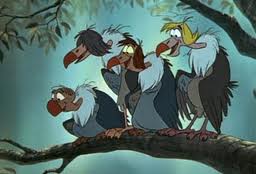
7/10. There is a lot that is lovely here and the film has an aesthetic all its own. The quality of the artistry here has increased substantially since The Sword in the Stone. The backgrounds, infused with a lot of richness and detail, look great here and always fully support the story as does the choice of colors utilized. Shots of the lush greenery, the gorgeous ruins, the green forest behind the vultures and the final shot with its stunning lighting change are especially impressive. The background behind the "dead" Baloo is grey and looks like it is weeping. The effects animation, evident in the moonlight, water and mist of the jungle setting, are top notch again, giving depth to details that had been neglected last time around.

Those sketchy elephants.
All of this is well-intergrated with the Xeroxed, sketchy quality of the characters (especially noticeable in the elephants). It feels like an artistic decision here, informed by the rough and tumble story being told, rather than an economic one. The character animation is stellar here, which isn't surprising when you consider how much focus the characters were given in this film. Notice how watching Mowgli trying to climb a tree, bounding up rocks, bear fighting with Baloo and marching with the elephants tells you as much about his character as the words that come out of his mouth. The fluid quality to Kaa's complicated snake body is something only great artists could get on celluloid so well. Everything is done so skillfully that it feels completely natural but it's given a touch of whimsy to heighten reality and give things a little punch. Even details as specific as Mowgli's crinkly nose or Baloo's expressive tongue are given special care. All of the details add up to some of the the most impressive character animation of any Disney animated film.

The Story:

Jumpin' and jivin', indeed.
7/10. After a classic storybook opening, we are launched into yet another episodic adventure story. We all know how well that went for us last time (meaning not well at all), but here it somehow works. Why? First off, the characters are much stronger this time around, giving more emotional heft to the proceedings. You genuinely care about what happens on their journey, keeping you invested throughout. There is also one overriding arc (that of Mowgli making his way safely back to the man village) that each of the escapades clearly fit into. The story is constantly being propelled forward and, instead of going from lesson to lesson, we move clearly through a plot that lets us glean our own morals from it, if we so choose. The action sequences are done masterfully here. The jokes and elements that would be out of place in the world of the story land instead of crashing with a thud. There is also something intangible at work in the film's success- a magic and charm here that makes it all work. I must say that in the end I agree with Walt about keeping the overall tone light with a few menacing touches. Letting the story get too heavy saps the essential element of joy out of the proceedings. It's a hard to strike a balance between the light and dark, but Disney at is best is masterful at it. They did an impressive job juggling the two here.

The Characters:

Don't it just make you all weepy? Just me? Ah...
8/10. Here we have the strongest aspect of the movie. All of the major and supporting characters are surprisingly dimensional with few exceptions and even the background figures are amusingly rendered. Some take umbrage with the fact that "name" performers were used and their personalities were integrated into the characters, but they are such good matches for who they portray here that any argument against their presence feels terribly hollow. Now, over 40 years after the film's debut, names like Phil Harris and Louis Prima are known to generations better as Baloo and King Louie than as the stars they were otherwise back in the day. It feels less like laziness (which will creep in when Phil Harris plays barely changed incarnations of himself in The Aristocats and Robin Hood as well) and more like a successful attempt to inject some life into the proceedings.

Ladies ain't nuthin' but trouble, kid.
All of the characters are wonderfully animated, with the slightly messy, Xerox style lines, and voiced brilliantly. They really tick, full of interesting details and emotional resonance. Mowgli, is performed by director Wolfgang Reitherman's son Bruce. (Along with Clint Howard, brother to Ron, as adorable little elephant Junior it enters the pantheon of magical child performances in Disney animated films.) He is the emotional center of the story and we experience the film more or less through his eyes, and since we relate to him easily, we become invested in what will happen to him. We love Baloo and Bagheera automatically because they are his main protectors. As the ultimate cool uncle figure and the parental protective type, these two make a very interesting couple whose contrasting personalities shine through in both the way they are drawn, which brilliantly marries animal behavior with human traits, and the vocal performances of hep cat Phil Harris and measured Sebastian Cabot.

They must be contemplating a lisp-off.
These strong core characters are surrounded by a cast of wonderfully conceived, rendered and performed supporting roles. There is no one central antagonist, but several great smaller ones fill the void, even if none of them rank among the Disney villain greats. Sterling Holloway (Winnie the Pooh, The Cheshire Cat) makes the most of his off-beat voice as the compelling and repellant Kaa, Shere Khan, voiced by George Sanders is appropriately menacing, and King Louie captures what is dangerous and exciting about jazz music in the performance of Louis Prima. Other smaller roles that make maximum impact in minimum screen time include Verna Felton (who also played an elephant in Dumbo, along with the Fairy Godmother in Cinderella and the Queen of Hearts in Alice in Wonderland) in her last screen role as Colonel Hathi's wife Winifred and the rest of the elephant brigade, the group of mop-topped vultures, and the many monkey subjects of King Louie. The only character that feels unduly empty is Shanti, the girl who coaxes Mowgli to the village by singing and making eyes at him. Having brilliant and grounded reaction shots of all three characters watching her only highlights how much she is a plot point rather than a character. In a film where pitch perfect characterizations reign, it feels like a missed opportunity. 

The Music:

Another gorgeous jungle shot.
7/10. Once again the score here is the work of the masterful George Bruns, who, like the rest of the creative team, is back in fine form after surprisingly forgettable work in The Sword in the Stone. The sound is appropriately mysterious and lovely for the jungle setting. Bruns is wonderful at making music that provides an emotional guide for the viewer and does not disappoint here. Listen in the key scene of Baloo's death for the tune of "The Bare Necessities" rearranged for the organ and played as a dirge. It's a brilliant way to pay tribute to a "lost" character in a potent way.

A fun side note for me, a huge 1964-1965 New York World's Fair fan, is that some of the music from the film was originally written for and used at the Fair. The fluttering flute theme that appears early on and becomes the major musical statement of the movie first appeared in The Ford Magic Skyway, which was created by WED Enterprises (aka Disney Imagineering). In the queue, miniatures were constructed of different far-off places to keep the visitors engaged while they waited for the ride. George Bruns scored the attraction and one of the areas contained a fantastic piece called "Serengeti Serenade". This is the piece of music that later became one of the major themes in The Jungle Book. I realized it when Tom and I were in the car on the way to Disneyland with all my Disney music on shuffle and it started playing. Tom got all excited about it, saying that he loved the score from The Jungle Book. I looked down at my iPod and clear as day, it was from my Walt Disney and the 1964 World's Fair CD set (which is completely amazeballs). I guess it goes to prove that reusing elements isn't the problem. It's all about how well you reuse them and if they are a good fit in there new home. Here, the music was as perfect a match for the jungles of India as it was the Serengeti Plains.

Best. Backscratch. Ever.
The songs here are, with one major exception, the work of the Sherman Brothers. The only song that they didn't write was "The Bare Necessities", which was part of a score written by Terry Gilkyson (who worked on several other less remembered Disney projects including the ever elusive Dr. Syn: or the Scarecrow of Romney Marsh) for the darker incarnation of the story. When that adaptation was canned, so was Gilkyson's score, but Walt was convinced to keep the one upbeat number of the batch and "The Bare Necessities" has since become a standard, and deservedly so, since it is arguably the best number in the song stack. It perfectly captures the character of Baloo and his carefree, folky spirit. They even manage to turn a backscratch into a dance break, which I can completely relate to.

The Beatles...uh...Monkees...uh...Vultures.
The contributions here by the Shermans are far better than what they created for The Sword in the Stone. Three are more or less pastiches, which the Shermans excel at, establishing characters by giving them a familiar musical voice and all work quite well. "Colonel Hathi's March" puts the elephants immediately into a military light, "That's What Friends Are For" is an odd but clever mixture of the Beatles' style with a barbershop quartet arrangement, and, most successfully, "I Wanna Be Like You" has a jazzy exuberance that is wild in both a fun and a dangerous way. The latter is helped tremendously by Louis Prima and his band's unique musical voice. Though these numbers may be out of place in a realistic depiction of the jungles of India a hundred years ago, they make sense in the story because of how well they support the story and, especially, the characters. It's also just plain easier to suspend your disbelief when the songs are this good.

This just makes me giggle.
The two other songs in the score are Kaa's "Trust in Me" and "My Own Home", which is sung by the girl that draws Mowgli into the village. "Trust in Me" is pretty fantastic, telling us all that we need to know about Kaa with a creepy melody and manipulative lyric and moving the story along as Kaa uses the song to tempt Mogwli to his doom. It gives me the heebie jeebies every time I hear it, yet it is hypnotic at the same time, which is exactly the kind of song that the character would sing. "My Own Home", on the other hand, feels rather generic to me and it seems odd to hear the voice of a twenty-something ingenue come out of the mouth of a character who looks about ten years old. It makes logical sense to utilize everyday human activities as the lyrics to a song that brings Mowgli to the man village, but those lyrics barely register as we cut back and forth to Baloo and Bagheera with the boy and the girl's song. The character feels more like a deus ex machina than someone that we care about at all. Since the only things she does is swoop in and sing this song, we care far less about the words coming out of her mouth than the other characters' reaction to them. 

The Gay Scale:

Baloo is wearin' the heck outta that skirt.
6/10. It is pretty easy to layer a gay read on The Jungle Book. It's about a young man who has been abandoned by his birth family and in search of an identity. He was raised by an adoptive family and a community that watches over him, knowing that he is an outsider in need of protection and acclimation to a new world and life that lies before him. This sense of reliance on a community outside the family is a common gay narrative. Now, this read may prove a bit troubling considering that Mowgli goes back to the man village to be "normal" again in the end, heeding the siren's call of a girl with a jug on her head. Who knows? Maybe Marcus Bachmann has set up reparative therapy there. Also, Shere Khan is a sexually ambiguous villain in a way that Scar in The Lion King will harken back to many years later.

What a cute couple.
The most interesting and valid read was pointed out to me this last time watching the film, and that is the idea that Baloo and Bagheera are co-parenting Mowgli. When it was mentioned, it threw the whole movie into an interesting new light to me. Bagheera is the more motherly figure, cautious, gentle and encouraging, trying to get Mowgli to leave the nest. Baloo (despite his impressive foray into Paris is Burning territory to give us hula monkey realness) is the father figure, bringing out the adventurous and scrappy parts of Mowgli's personality. They are a yin and yang that cooperate to help him on his journey. The fact that they become parental figures to him gives the film emotional weight, which becomes very obvious when Baloo "dies" at the end of the film. We are so moved because we have grown to love him as a cool dad, just like Mowgli has. That final shot of the two of them walking into the sunset together just seals the deal.

The Bottom Line:

Mowgli and Baloo as hotel decorations at
the Art of Animation resort in WDW.
7/10. If not at the level of what Disney animators are capable of at best, The Jungle Book is still fun, breezy, well-done and artistically solid, with brilliant characters, great songs, an evocative score, emotional depth, a lot of heart and charm to spare. My opinion of it is actually quite a bit higher this time watching than when I saw it for the first time as an adult in 2010. I think I was still so miffed by what the Xerox process had wrought artistically that I was being blind to what was lovely and done so right here. It feels like most of what The Sword and the Stone got wrong, The Jungle Book gets right. It's like the creators wanted to prove that they could take the elements that made the former a failure and get them to work. Work they did, giving us an episodic adventure story with elements that don't belong in the jungles of India at the turn of the last century. The difference here is the palpable joy, the relatable and lovable characters, the clear story arc, and the more ambitious artistry. I have really come around to dig on The Jungle Book in a major way. Solid.

The Miscellanea:

I knew there would be a fairly large chunk of videos this week, and I found some really weird and awesome gems. First off is a clip that features footage of Louis Prima performing "I Wanna Be Like You" with his band. It's very cool to see the way that they really physically based King Louie and the other monkeys on Prima and his band. (By the way, Disney released a limited edition Archive Collection CD of Let's Fly With Mary Poppins featuring Louis and his wife Gia Maione doing swingin' versions of songs from the great Sherman Brothers score. Though some CDs in the series are expensive and hard to track down, it's easy to find cheap copies on Amazon of this one, and it's worth it for the awesome "Sister Suffragette" and Italian version of "Supercalifragilisticexpialidocious" alone. PS I love the fact that "Supercalifragilisticexpialidocious" wasn't autocorrected!)


Journey Into the Jungle Book was one of the opening day attractions at Animal Kingdom when it debuted in 1998 and it lasted for a year before being replaced with a Tarzan stage show. I have come to have a newfound appreciation for theme park shows over my last few visits as Tom and I decided to stop avoiding them like the plague. Several have been pleasant surprises and Finding Nemo the Musical  at Animal Kingdom now is one of the best shows playing anywhere in the country. This one, however, seems a bit flat. The elephants have two legs. There's a trampoline that is supposed to telegraph carefree joy but instead induces flop sweat. The design and puppetry (save for the impressive Shere Khan) are not terribly imaginative and look bleak. Mowgli is too old. It feels like an amateur hour highlights reel rather than a fully-formed stage show. But if it took starting here to get us to shows like Finding Nemo, then so be it. Gotta start somewhere.


With The Jungle Book's enduring popularity, some sequel action was all but inevitable. There was an animated series called Talespin. Debuting in 1990, when I was 10 years old, it uses familiar characters from the movie, but in a completely different context, so it's not really a proper sequel. I vaguely remember from my childhood and had friends who were all about it, but I think I was too busy watching Hey Dude on Nickelodeon or doing something dorky like reading to pay it much mind at the time. But that theme song sure sounds familiar!


They released an actual sequel to the original film in 2003. Jungle Book 2 was released into theaters instead of going direct to video first, though it hardly set the box office on fire. I haven't seen it yet, but from plot synopses and trailers, it looks pretty derivative and artless. It doesn't take much imagination to come up with a story where Mowgli gets bored in the village and wants to go back to the jungle. It's obvious to the point of insulting, which is often status quo in these low-quality, brand-diluting, money-grubbing sequels. Props should be given, though, for the brilliant casting of John Goodman as Baloo.


This is a Jungle Book video game from the early nineties. I'm mostly including it because the pixelated awesomeness of this era of gaming makes me giggle. I'm not very good at video games, for the most part, but my husband, Tom, is a fierce gamer. He could probably blow through this puppy in an afternoon while I sat next to him on the couch, reading.


Someone with a lot of patience assembled this video showing reused animation in The Jungle Book. I'm not gonna lie and say the recycled bits weren't noticeable. We even commented on them while watching for DATE Night, but they never detracted from our enjoyment of the film. Seeing them all strung together like this, however, is kind of eye-opening. They were really up against a wall and being forced to take short cuts that they never would have dreamed of taking during the golden ages. I mean, the animators balked at first about having live model reference footage, and now they were borrowing animation from the self-same movie they were using it in? Wowza.


If the opening bit of this next video is to be believed, there was a sequel planned for The Jungle Book back in the day. The film never came to fruition but some of the songs, such as this one called "Jungle Fever", survived as an album called More Jungle Book. It's not bad, but not in quite the same league as the songs from the original. I'm glad they left well enough alone. At least for a few decades until they trotted out Jungle Book 2.


This is the first I've heard of the ToonTown Tuners, who are a saxophone group that played in Walt Disney World, though I'm not sure if they still do. Regardless, they are quite impressive. This is them performing a medley of Jungle Book songs.


I have been a fan of Scottish singer/songwriter Paolo Nutini for several years. His album These Streets is in the same raspy, Brit soul vein as James Morrison and I love it. He bubbled up for a bit a few years ago and then faded away again, sadly. I had no idea that he did a cover of "I Wanna Be Like You" in his live act until I was preparing this blog entry. It is fully awesome. Please to enjoy, and then seek out These Streets. I promise you'll likey.


Of course Big Bad Voodoo Daddy would cover "I Wanna Be Like You". And of course it would rock my socks off. There was never any doubt.


This is Craig David (Remember when he was a thing? Yeah...me neither.) showing everybody how to decimate a Disney classic like "I Wanna Be Like You". Dannii Minogue should be mortified for unleashing this onto an undeserving public. He has taken all of the groove and heat out of one of the swingingest numbers know to man and turned it into an undercooked slow jam. For shame.


I was really surprised at the number of interesting covers of "Trust In Me" that were floating around. This one is from Selena Gomez, who, along with Miley Cyrus, is making me reconsider my burning dislike of former Disney Channel tween moppets. This version shows a pop star who is obvious trying to grow up and be a bit "dangerous", but can't fight the bubblegum in her soul. I enjoy it immensely. (Sorry, Tom.)


Now, for something completely different. Siouxsie and the Banshees managed to do a cover of "Trust In Me" that truly is dangerous. It's creepy and alluring and offbeat. This is how to subvert a Disney song, ladies and gents. This makes me want a Florence + the Machine Disney cover album to happen. Who can arrange that, please and thanks?


This version of "Trust in Me" is by a British singer of Indian descent named Susheela Raman. It's got a world music flair to it and her voice is very interesting and expressive. This version actually feels like it would be right at home in the film itself.


This last version of "Trust in Me" is by the Holly Cole Trio, and it may be the sexiest interpretation of the song that has ever been recorded. Holly Cole is a Canadian jazz singer who is quite well-respected and I've loved her ever since hearing her definitive version of "Calling You". She has a rich, smoky voice that really wraps around a lyric and makes something special out of it. Her albums usually contain surprising covers that you wouldn't expect to be done in her style, yet make complete sense when you her her arrangements. If you want more, I recommend her album Dear Dark Heart that has a smashing cover of "River" or the live It Happened One Night album that has her sublime "Calling You". 


This sixties-riffic studio recording "The Bare Necesssities" is from one of the Disneyland records that proliferated back in the day. It's good for a chuckle.


Here is Louis Armstrong doing "The Bare Necessities". It is the definition of perfection. You can find it on the Disney Songs the Satchmo Way album, which is one of my favorite Disney CDs ever. It is essential.


I'm not a huge fan of reggae, which has a deep rooted association with homophobia, but this Disney Reggae Club album exists. Steel Pulse's version of "The Bare Necessities" is good times, if this kind of thing is your jam.


This is Astrud Gilberto, best known as the bossa nova singer from "The Girl From Impanema" doing "The Bare Necessities" with her son. It is completely charming.


Just when I had given up hope of finding a fun cover of "My Own Home", which was mostly represented by tweens armed with a karaoke track staring straight into the camera and being overly earnest, I found this dude playing it on the theremin. It's totes boss.


So, what do you think? Does The Jungle Book fall under the banner of the second golden age of Disney animation or does it just miss? Do you even think it's good enough to deserve the distinction? How do you feel about the direction that the films are heading? Am I too critical of the era's animated films? For our next DATE Night we will be traveling back to turn of the (twentieth) century France with a stop in a jazz club / attic sprinkled with late-sixties psychedelia for The Aristocats. If you bring hallucinogens, that's your thing, man, but I'm not nursing you out of your bad trip. I'll be too busy practicing my Eva Gabor accent. Sorry bout it.